
Kosmos: A Soviet Space Odyssey - Part 2
5 - 28 August
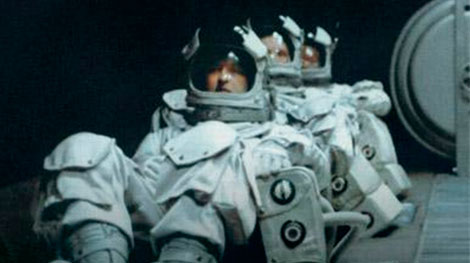
The British Film Institute, in association with Academia Rossica, brings the best of Soviet science fiction to London. Highlights include Tarkovsky's Stalker and cult favourite Kin-Dza-Dza.
Programme
Dreaming of Space
25 Aug 18:30
28 Aug 20:50
Emigration is contrasted with space flight as a route out of Soviet torpor in this award-winning drama.
First on the Moon
18 Aug 20:40
20 Aug 17:50
Aleksei Fedorchenko simulates 'archive' footage to suggest that Soviet space exploration began in 1938.
Icarus XB-1
5 Aug 18:40
7 Aug 18:20
In the year 2163, a philosophical crew travel through space towards a mysterious white planet.
The Interrogation of Pilot Pirx
11 Aug 20:40
14 Aug 18:40
A rocket pilot is hired to test a new robot crew in this cautionary tale about technological progress.
Kin-Dza-Dza
14 Aug 20:20
19 Aug 18:10
An irreverent steam-punk satire on Soviet society.
Paper Soldier
26 Aug 20:40
27 Aug 18:10
An iconoclastic take on life in and around the Baikonur cosmodrome in 1961.
Stalker
6 Aug 19:50
8 Aug 19:50
Andrei Tarkovsky's compelling exploration of faith, desire and desperation.
Visitor to a Museum
17 Aug 20:20
21 Aug 17:30
An extraordinary vision of a society at the mercy of vast and irrational forces.
See www.bfi.org.uk for further information and to book tickets.
Introduction to Kosmos: A Soviet Space Odyssey by Rhidian Davis, BFI
Yuri Gagarin's momentous journey in Vostok 1 to become the first human in orbital space on 12 April 1961 was celebrated around the world as one of mankind's greatest achievements. Simultaneously Soviet cinema was experiencing an artistic renaissance as Khrushchev's cultural 'thaw' in the late 1950s and early 1960s brought fresh energy and optimism into film production.
The rocket-fuelled science fiction genre was partly modelled on recent US productions, but underpinned by distinct cultural traditions, notably utopian Russian Cosmism, which blended technology, fantasy and theology in pursuit of liberation and eternal life in the stars. State-sanctioned utopian narratives present some dramatic conundrums, even for writers as skilled as Stanislaw Lem, but the visionary art direction of these big-budget productions more than compensates for any deficits in interpersonal conflict or excesses of communist dogma. The tradition of lavish set design, established by the 1920s blockbuster Aelita, returned 30 years later, as did some of the original artists whose work underpinned the silent classics, such as Ernst Kunstmann, veteran of Fritz Lang's Metropolis and special effects supervisor on the first GDR contribution to the genre, Silent Star.
We spotlight the work of Russian visual-effects pioneer Pavel Klushantsev, who created stunning visions of man's voyage to the stars a decade before Stanley Kubrick's 2001: A Space Odyssey. His story is told in The Star Dreamer, while his elegant educational sorties across the cosmos are presented in connection with this Danish documentary.
Many of these films remain virtually unknown in the West, though some did find their way on to the B-movie circuit in the 1960s - albeit mauled beyond recognition when enterprising US producers bought them cheaply at the height of the Cold War. Under Roger Corman's guidance, Francis Ford Coppola, Peter Bogdanovich and Curtis Harrington cut their teeth refashioning communist science fiction to suit Western sensibilities. So it is that Kariukov's fraternal encounter with beings from another world in Toward Meeting a Dream becomes a sexually charged nightmare encounter with a green blood-sucking alien in Queen of Blood. But then that's capitalism for you. Indeed, a 21st-century audience might find the socialist strictures that saw these films re-written, or written off, almost as exotic as the flora and fauna on Venus.