
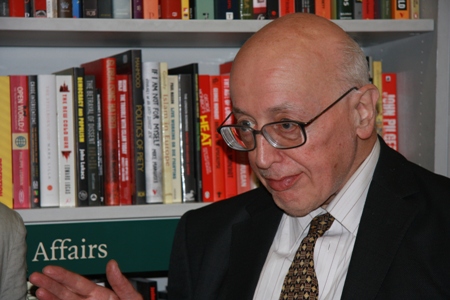
Martin Dewhirst
I was delighted and astonished when I received the invitation to be one of the judges of this year’s ‘Rossica’ Translation Prize. Delighted – because, by accepting, I would be able to indulge myself with a clear conscience in reading (or, as it often turned out, rereading) many works of Russian literature rather than doing what I all too often do – reading works about Russian literature (and various other things). Astonished – because I am not a prolific or high-profile translator of Russian literature, so I was unsure about why I had been chosen. However, not being known for false modesty, I did feel that I was reasonably well qualified for the work ahead. It is almost half a century since I did my first commercial literary translation. While I was a British Council student (stazher) at Moscow and Leningrad Universities during the 1959-1960 academic year, I was asked to translate Viktor Rozov’s play Neravnyi boi (Unequal Combat) for Granada Television, and greatly enjoyed the challenges the text presented. (Maybe I didn’t rise to the challenges, because my version was, in the end, never performed.) Later, in 1977, at the height of the ‘period of stagnation’, Robin Milner-Gulland and I published at Penguin Books an anthology called Russian Writing Today. Looking through it over thirty years later, I don’t feel embarrassed, as the works we selected and the translations we edited or did ourselves show that, whatever the political climate in the Soviet Union, the best of Russian literature was anything but stagnant. Of course, it’s one thing to translate literature and an altogether different matter to judge literature, whether in the original or in translation. Here again, I felt that I was likely to be able to do a professional job for ‘Rossica’. Fifteen years ago I was one of the five judges of the Booker Prize for Russian prose fiction, and I well remember the friendly but heated discussions we had before finally there was a majority ready to vote for one particular work (I was in the dissenting minority, and not for the first or the last time). Moreover, since the 1990s I have been the (or a?) reader of the Russian entries for the annual John Dryden Translation Competition, run from the University of East Anglia in Norwich. (Incidentally, this University offers a one-year MA course in Literary Translation, as well as an MA in Applied Translation Studies and PhDs in Translation Studies.) Thus I know something about both the practice of translation and the theories of translation.
I am writing these lines after we have drawn up the Short List but before we have decided on the winner. I was delighted that there were so many (originally 58) submissions (and I know of other translations that were not submitted), suggesting that in the English-speaking parts of the world there is still (or again) a healthy interest in and market for much of the best of Russian literature, both old and new. It is a good sign that, although we had to be cruel to many deserving translators, we felt we simply had to break one of the guidelines and shortlist seven translations, not the stipulated five or six. The Prize is, of course, awarded to what the judges think is the best translation, and not the best original, and this has made me think long and hard about whether to prefer a brilliant translation of a mediocre original to a far from adequate translation of a masterpiece. One of my major disappointments while judging this year’s entries was to discover that far too often some of the publishers have let their translators down by slipshod editing and sloppy proof-reading (assuming the publishers did not ask the translators themselves to vet the final product before it went to the printers). Other problems concern the provision (or not) of introductions and footnotes or endnotes, providing background and explanations for readers not well acquainted with details that the author of the original text knows his Russian readers will understand. But of course, the cost of a translation is high, and one can hardly expect every publisher to maintain the highest standards of production. This is an important consideration, because the Rossica Prize is divided (not necessarily equally) between the translator and her or his publisher.
Among the other problems facing judges of such competitions are the not necessarily pedantic distinctions that can be made between translations on the one hand and versions, imitations and adaptations on the other hand. I was trained (in the RAF!) as an interpreter and remember being told that whereas children were supposed to be seen and not heard, interpreters were supposed to be heard and not seen. (Indeed, I still prefer to interpret in a booth, rather than in view of the audience.) To what extent does this also apply to translators of literature, especially poetry?
To what extent should (s)he be allowed to compensate or even overcompensate for the impossibility, in languages as different from one another as Russian and English, of conveying every single detail and nuance in the original, especially in a great original? As a rule, a literal translation of a literary work falls completely flat, so translators are obliged to add at least something of their own, while remaining as much as possible in the shadows. To what extent should the rhythms and rhymes of the original, if at all possible, be retained? Should the translator tend, when in doubt, to domesticate or to foreignise the translation? How hard should translators try to make their readers forget that they are reading a translation? Naturally, the easy way of avoiding a clear answer is to say that one can’t generalise and you have to take each individual case on its merits. But what then happens, in a competition, if there is a dead heat?!
I have learnt a lot from helping to judge the entries to this competition. Many of the submissions were clearly labours of love, carried out not at all or not mainly for filthy lucre. The overall standard strikes me as higher than it was fifty years ago, when I was a beginner, and one of my most encouraging discoveries, thanks to the 28 entries for the Young Translators’ Prize, is that standards in the future should be higher still, partly because it is now so much easier for people with native English and a really good knowledge of Russian and Russia to cooperate with people with native Russian and a really good knowledge of English.